
Curious about purchasing beef directly from a local farmer but unsure where to begin? We’ve got you covered with this quick introduction to purchasing cattle directly from a local farmer!
While there are several ways to connect with local cattle farmers, the easiest may be word of mouth: asking friends, family and neighborhood vendors for advice. State university extensions provide another opportunity to learn about local farmers. The Ohio State University Extension is an invaluable resource for Buckeyes, every Ohio county has its own Extension office which provides residents with agricultural resources.
A simple internet search for local cattle farmers may also prove helpful. There are aggregate sites, such as LocalHarvest and EatWild, which may streamline an otherwise unwieldy search. In addition, local newspapers, magazines and social media groups occasionally publish profiles of local farmers.
The first question when purchasing cattle directly from a farmer is how much beef does a cow provide?
Very roughly speaking, an eighth of a cow is about 50 pounds of beef (roughly half in cuts of beef and half in ground beef). A quarter of a cow is about 110 pounds of beef (roughly half in cuts of beef and half in ground beef). A half of a cow, sometimes referred to as a ‘side of beef,’ is roughly 220 pounds of beef (about 100 pounds of ground beef, the rest in cuts of beef). An eighth of a cow will fill a standard home kitchen freezer; an additional storage freezer is recommended when purchasing a quarter or a half of a cow.
When discussing a beef purchase with a local farmer, there are several important terms which may be unfamiliar to a new customer.
Live weight, sometimes referred to as ‘on the hoof,’ is the weight of the cow while it is alive.
Hanging weight, sometimes referred to as ‘on the rail,’ is the weight of the cow after it is prepared for the butcher (typically, the hanging weight is 60% of the live weight of a cow).
Farmers often calculate their cattle prices based on a calculation of both the hanging weight and the live weight of the cow. For example, if a farmer quotes a price of $2.40 per pound hanging weight, the final price for that cow will be $4.33 per pound ($2.40 divided by .60). The butcher’s cost is a separate, additional price.
Farmers may also describe their cattle as grass-finished or corn-finished. Generally speaking, family farms allow their cattle to roam freely on the farm’s pastures. All pasture-raised cows are grass-fed, but some farmers feed their cattle corn during the final stage before harvesting the cow. The corn diet produces more fat in the cow, sometimes referred to as ‘marbling.’ Alternatively, farmers may continue to use grass as feed for the cow’s entire life. The grass diet produces lean beef with less fat. Thus, a grass-finished cow tends to weigh less than a corn-finished cow.
Farmers often partner with local butchers who age and cut the beef per the customer’s instructions.
When discussing a beef purchase with the farmer’s butcher, there are several important terms to understand.
The butcher divides a cow into halves, each half consists of the front quarter and the hind quarter. The U.S. Department of Agricultural divides each half of a cow into eight regions, referred to as ‘primal cuts.’ The front quarter contains the brisket, ribs (short ribs and rib steaks), chuck roasts and ground beef. The hind quarter contains the loins (short loin, tenderloin and sirloin), the flank and the rounds.
Because the front quarter contains mostly roasts and ground beef and the hind quarter contains mostly steaks, some butchers prefer to sell split half quarters instead of either the front quarter or the hind quarter. In a split half quarter of a cow, the customer receives a greater variety of cuts.
When discussing a beef purchase with the farmer’s butcher, the butcher will be able to cut a half a cow, the front quarter and the hind quarter per a customer’s instructions (for example, how thick the steaks should be cut, what size should the roasts be cut, ect.).
When purchasing an eighth of a cow, the two customers who are purchasing that quarter of a cow must agree on the instructions for the butcher. When purchasing a split half quarter, the two customers who are purchasing that half of a cow must agree on the instructions for the butcher.
When a farmer partners with a local butcher, the butcher’s price is often paid directly to that butcher, separate from the farmer’s price. It is important to note that weight is lost during each stage of the butchering process, so the amount of beef that is ultimately purchased for the freezer will not exactly match the hanging weight quoted by the farmer.
Whether through purchasing beef or any other products, enjoy the bounty provided by your local family farmers!
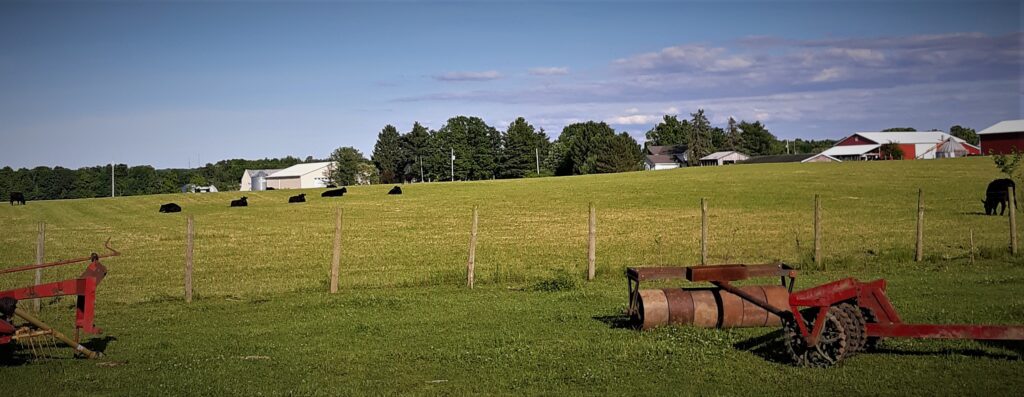
Cattle on The Farm
great info! Thanks
Thank you!